When trading options, one of the most overlooked yet critical factors is Buying Power (BP). It’s not just a number on your brokerage screen—it’s the lifeline that determines what trades you can execute and how much risk you can take on. In this post, we’ll explore how BP impacts your decision-making, especially when selling spreads, using a real-world scenario.
What is Buying Power?
Buying Power represents the amount of capital your broker requires you to maintain in your account to cover potential losses. When you sell options—especially naked options—your BP requirement increases because the broker wants to ensure you can handle the risk.
Scenario: Your Current Portfolio
Imagine you hold:
- AAPL Call Spread (e.g., short 245 call, long 255 call)
- NVDA Put Option (long or short)
Now, you’re considering selling additional spreads. Here’s where BP becomes a game-changer.
Case 1: Selling an AAPL Put Spread
If you decide to sell an AAPL put spread, your BP impact is minimal or even zero. Why? Because you already have AAPL positions, and the broker recognizes the offsetting risk. Your existing AAPL call spread and the new put spread create a more balanced position, reducing overall exposure.
Case 2: Selling an NVDA Put Spread
Here’s the twist: if you try to sell an NVDA put spread, your BP requirement increases significantly. Even though you already have an NVDA option, it’s a call, not a put. The broker sees this as adding risk rather than offsetting it. So, your available BP drops, limiting your ability to open other trades.
Case 3: Selling a GOOG Put Spread
If you want to sell a GOOG put spread—a ticker you don’t currently hold—the BP impact is even greater. Since there’s no existing position to offset the risk, the broker requires full margin for the new spread.
Visualizing BP Impact
Here’s a quick look at how BP impact varies across these scenarios:
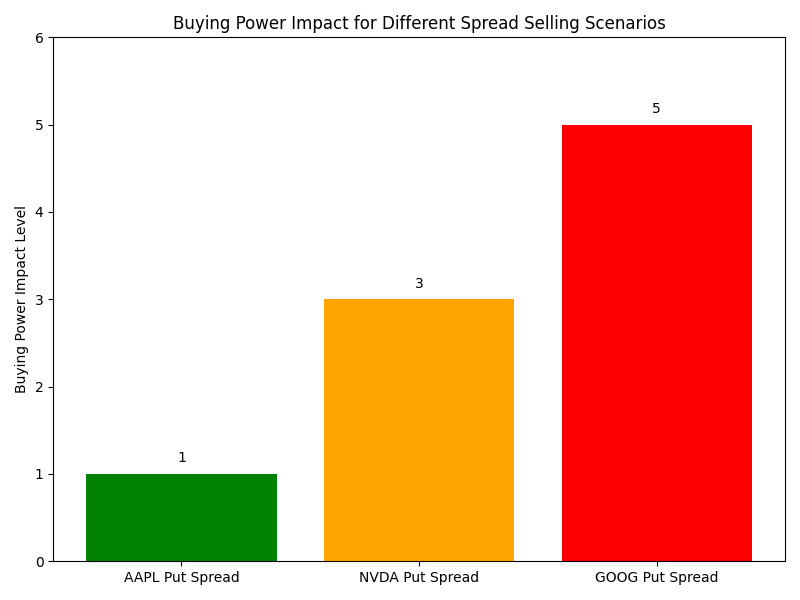
- AAPL Put Spread → Minimal BP impact
- NVDA Put Spread → Moderate BP impact
- GOOG Put Spread → High BP impact
Why Does This Matter?
Your BP dictates your flexibility. If you’re close to your BP limit, you might have to:
- Close existing positions to free up BP.
- Choose smaller spreads (narrower width) to reduce margin requirements.
- Prioritize trades based on risk/reward and BP impact.
Tips to Optimize Buying Power Usage
- Sell Spreads on Existing Positions
Adding spreads to tickers you already hold can reduce BP requirements because brokers recognize offsetting risk. - Use Defined-Risk Strategies
Credit spreads (like vertical spreads) cap your risk and require less BP than naked options. - Close Unused Positions
Free up BP by closing positions that no longer fit your strategy or have minimal profit potential. - Consider Narrower Spreads
Reducing the width of your spreads lowers margin requirements, freeing BP for other trades. - Monitor BP Before and After Each Trade
Always check the BP impact in your broker’s platform before executing a trade to avoid margin calls.
Summary
- Buying Power is a key constraint in options trading that influences what trades you can make.
- Selling spreads on tickers you already hold is more BP-efficient than opening new positions on unrelated tickers.
- Always plan trades with BP in mind to maintain flexibility and avoid margin issues.
- Use strategies like defined-risk spreads, closing unused positions, and monitoring BP regularly to optimize your trading capital.