Managing options trades often requires flexibility. Rolling positions can help minimize losses and extend time for your thesis to play out. Let’s analyze a real-world example using Apple (AAPL).
The Situation
- Original spread: Short $252.5 Call / Long $257.5 Call expiring Oct 10.
- Rolled to: Short $245 Call / Long $250 Call expiring Oct 31.
- Current AAPL Price: $255.45
This roll moved the strikes deeper ITM and extended the expiration by three weeks.
Updated Payoff Analysis
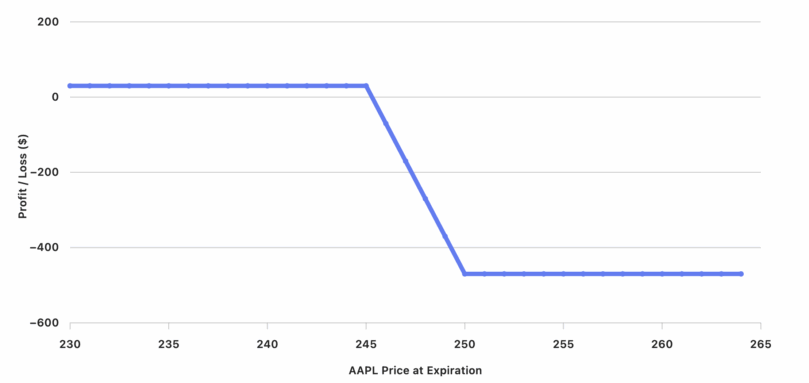
For the new spread:
- Width: $5
- Credit Received: $0.30
- Max Profit: $30
- Max Loss: $470
- Breakeven: $245.30

Important Note:
You also keep the credit from the original spread when rolling. This reduces your overall loss compared to closing outright. For example, if the original spread gave you $1.50 credit, your total collected premium after rolling is $1.80 ($1.50 + $0.30), lowering your effective breakeven and risk.
Interpretation:
- If AAPL closes below $245, both calls expire worthless → you keep $30 credit.
- If AAPL closes above $250, max loss = $470.
- Breakeven at $245.30.
Benefits
✅ Defined Risk: Max loss capped at $470 per spread.
✅ Time Extension: More time for AAPL to move favorably.
✅ Improved Position: Deeper ITM strikes reduce extrinsic value risk.
Drawbacks
⚠ Transaction Costs: Multiple legs mean higher commissions.
⚠ Complexity: Requires active monitoring and management.
Risks
- Upside Risk: If AAPL rallies above $250, you hit max loss.
- Liquidity: ITM options can have wider bid-ask spreads.
- Rolling Trap: Avoid rolling endlessly—have a clear exit plan.
Educational Takeaways
- Always Calculate Breakeven: Here, $245.30 is key.
- Check Greeks: Rolling deeper ITM increases delta, lowers theta.
- Set Rules: Decide when to stop rolling and accept the loss.
Current Market Context
AAPL trades around $255.45, so the new spread is fully ITM. The roll likely aims to capture intrinsic value and reduce time decay while waiting for a pullback.
✅ If you’re in a similar situation:
- Confirm the thesis still holds before rolling.
- Compare rolling vs. closing outright.
- Use defined-risk strategies like vertical spreads to control exposure.