
Recently, I closed a vertical call spread on Apple Inc. (AAPL), both legs expiring on August 25:
- Long AAPL 222.5 Call
- Short AAPL 227.5 Call
This bullish spread was originally sold for a $0.18 credit, aiming to profit from moderate upward movement in AAPL while capping risk. However, the trade didn’t go as planned—and the lessons learned were invaluable.
📘 What Is a Vertical Call Spread?
A vertical call spread is an options strategy that involves buying and selling call options with the same expiration date but different strike prices. It’s used to:
- Limit risk while maintaining upside potential
- Reduce the cost of buying a call outright
- Define maximum profit and loss
In this case, the goal was to benefit from AAPL rising moderately, without risking large capital.
🧮 Trade Breakdown
- Original Credit Received: $0.18
- Closing Debit Paid: $0.37
- Net Loss: $0.19
At the time of closing, I accepted a loss to avoid further risk. The decision was made at market open, and I learned the hard way that brokerages don’t execute at the best available price during open—they execute at the price you specify.
⏳ What If I Had Waited?
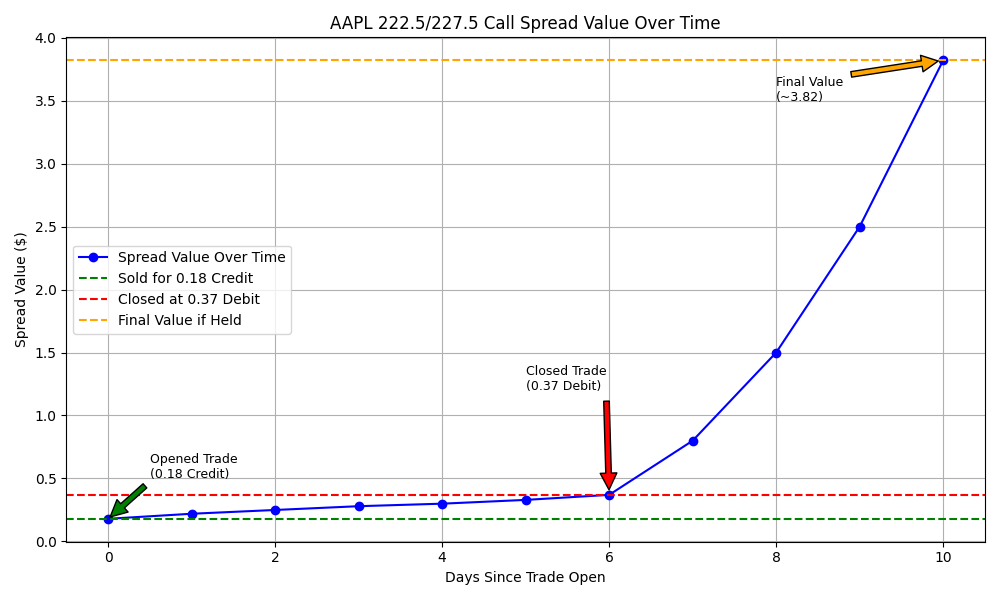
Had I held the position longer, the spread would have ballooned in value. The long call surged deep in-the-money (ITM), and the spread’s value approached $3.82—a massive increase that would have cost me hundreds more to close.
This reinforces a critical point: sometimes taking a small loss early is far better than risking a much larger one later.
📊 Spread Value Over Time
Here’s a chart showing how the spread’s value evolved from trade open to expiration:
💡 Expanded Lessons Learned
1. Execution Timing Matters—Especially at Market Open
Brokerages execute limit orders at the price you set, not the best available. Consider waiting a few minutes after open for spreads to stabilize.
2. Risk Management Is More Than Just Stop-Losses
Closing early—even at a loss—can prevent deep ITM exposure, assignment risk, and inflated exit costs.
3. Don’t Chase Perfection—Act on Probability
Waiting for the “perfect” exit can backfire. Prioritize capital preservation over squeezing every cent.
4. Know Your Spread’s Behavior Near Expiration
Time decay accelerates, bid/ask spreads widen, and ITM options become more sensitive to price changes. Be proactive.
💬 Let’s Talk Trading
Have you ever closed a trade early and avoided a bigger loss?
Or maybe you held on too long and learned a tough lesson?
Share your experience in the comments or tag me in your own trade breakdown. Let’s learn from each other and grow as traders.